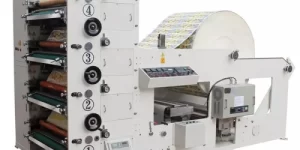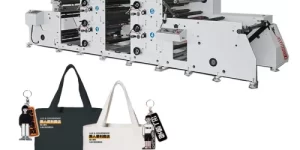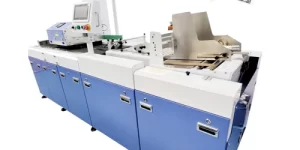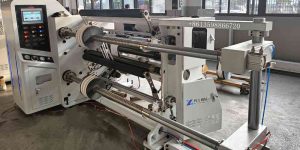
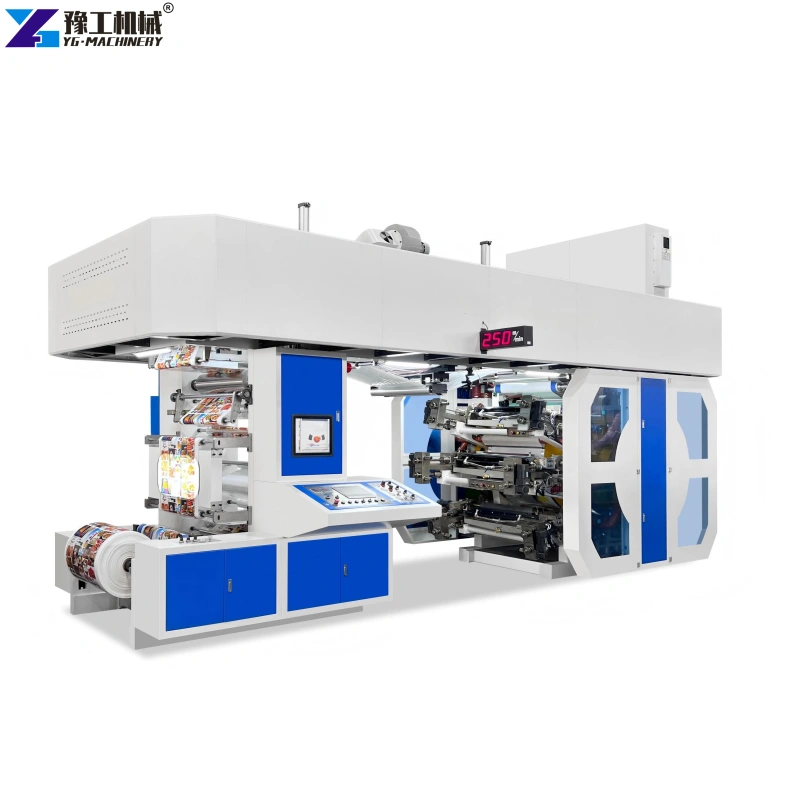
In today’s high-volume, high-precision flexible packaging market, the CI flexo printing machine stands as the only standard solution for stretchable films. Traditional stack-type flexo printing machine setups often suffer from major registration errors on thin materials due to multiple material turns. As a dedicated manufacturer, YG Machinery has optimized the central impression cylinder and dual closed-loop servo tension systems to push registration accuracy to $\pm0.05\text{mm}$, giving you the reality of optimized production efficiency.
Why Does the Central Impression Cylinder Layout Deliver ±0.05mm Accuracy?
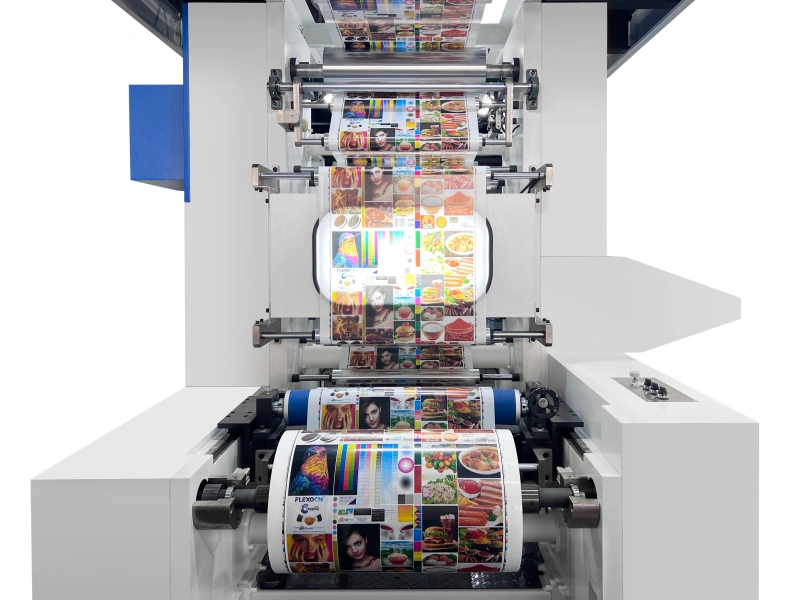
The core of a CI flexo printing machine is its arrangement of all color stations around one single central impression cylinder. The substrate locks tightly onto the cylinder surface, moving with it to complete multi-color overprinting sequentially.
- Zero-Stretch Control: No relative movement happens between color stations, which stops ghosting caused by film stretching.
- Thermal Control Wall: The cylinder runs a dual-directional water cooling system to stop thermal expansion from messing with registration.
- Anilox Roller Transfer: Paired with high-line ceramic anilox rollers and chambered doctor blade systems, it keeps ink layers uniform at high speeds.
Technical Tip: When printing on thin substrates like 12-micron PET or BOPP, always run the cylinder water-cooling system to keep temperatures between 22°C-25°C.
Technical Metrics Comparison: CI vs. Traditional Flexo Presses
When looking at the overall printing machine price, technical specifications directly dictate your return on investment.
| Technical Metric | CI flexo printing machine | Unit-Type Flexo Press | Stack type flexo printing machine |
| Registration Accuracy | ±0.05mm (Ultra-High) | ±0.15mm (Medium) | ±0.25mm (Low) |
| Max Running Speed | 200-400m/min | 100-300m/min | 50-150m/min |
| Equipment Cost | Higher | Medium | Lower |
| Film/Foil Adaptability | Excellent | Fair | Poor |
| Double-Sided Printing | Requires turn bar system | Supported (Single pass) | Supported (Inherent) |
As the data shows, the upfront cost of a CI unit is higher than a basic flexographic printing press. However, its massive output and low waste rate justify the asset value easily.
Multi-Industry Workloads and Technical Adaptability
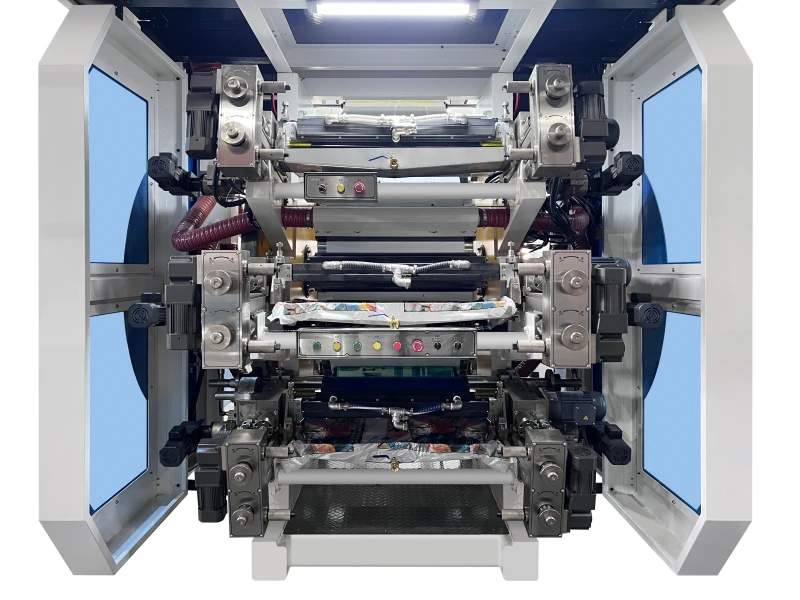
Different packaging substrates demand distinct web tension settings and drying capacities from a CI flexo printing machine.
- Food-Grade Thin Films (PE/BOPP): These jobs require micro-tension control down to 10-50N. High tension stretches the film, while excessive drying heat shrinks it.
- Aluminum Foil and Multi-Layer Laminates: These materials are rigid and wrinkle easily. The machine needs air shafts and automatic edge position control (EPC) to ensure perfect tracking.
- Premium Non-Woven Fabrics & Heavy Paper: These require high-power infrared (IR) or ultraviolet (UV) drying systems. They absorb more ink and must dry fast to prevent smudging.
Technical Tip: When switching to paper stock, increase the doctor blade pressure slightly and clean paper dust off the ceramic anilox roller frequently to prevent cell clogging.
Technical Upgrade Success Case: High-Precision Packaging Line in Dominican Republic
In the Dominican Republic, a packaging factory owner named Mr. Carlos was struggling with poor registration. He ran food-grade PE film on an old flexographic printing press, losing 12% of his raw materials to unstable web tension. Mr. Carlos needed to start a change.
We built a custom 6-color CI flexo printing machine for his shop. To handle the humid Dominican climate, we upgraded the line with high-capacity enclosed drying hoods. With this upgrade, Mr. Carlos now runs steadily at 260m/min. Best of all, his registration error stays under ±0.05mm, dropping his waste rate below 1.5%. He cut material costs and secured a long-term contract with a major supermarket chain.
24-hour sales hotline: +8613837112713
CI Flexo Printing Machine FAQ
Since the substrate hugs the central drum tightly, it only prints one side per pass. To print double-sided, you must install an independent turn bar system before rewinding.
Higher LPI delivers less ink for fine dots and sharp text. Lower LPI delivers a thicker ink layer, making it ideal for solid color blocks.
Clean the cylinder surface daily using a dedicated, non-corrosive solution. Never let hard tools bump the drum, because even a tiny scratch can ruin the print quality entirely.