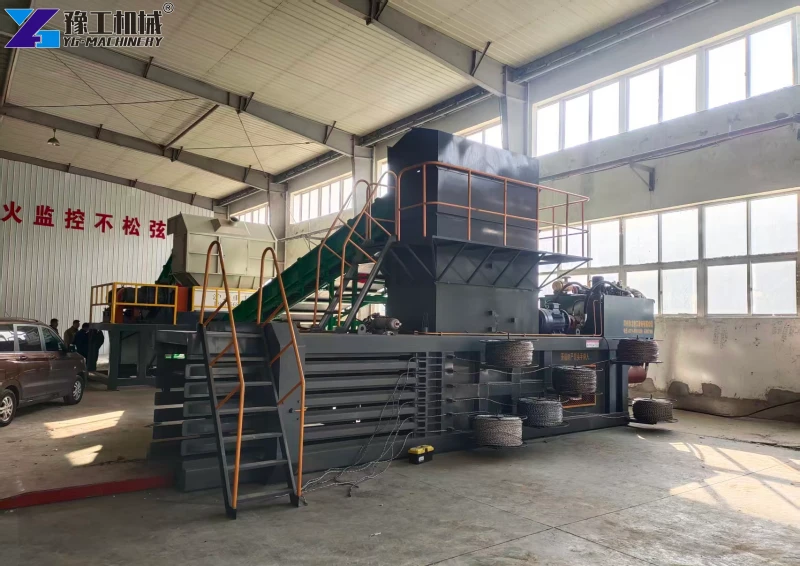
When shopping for an automatic baler machine, many international buyers fall into a common trap. They either blindly chase the highest tonnage or look only at the cheapest price tag. As an experienced industrial machinery selection consultant, I regularly see recycling yards plagued by skyrocketing electric bills or persistent gate-jamming issues caused by highly elastic materials.
Today, we will skip the standard corporate fluff where suppliers only praise their own gear. Instead, we provide an objective, data-driven comparison of clamping-arm, lifting-gate, and energy-saving servo horizontal baler designs to help you secure the highest return on investment calculation.
✍ Selection Tip: When evaluating an automatic baler machine, always calculate your actual daily dumping frequency first rather than relying on theoretical maximum factory outputs. If the hopper opening size does not match your wheel loader grapple, a massive tonnage is completely wasted.
Automatic Baler Machine Parameter
| Model | YG-160 | YG-180 | YG-200 | YG-250 | YG-300 |
| Suitable for packaging materials | Cartons/Solid waste/Plastics | Cartons/Solid waste/Plastics | Cartons/Solid waste/Plastics | Cartons/Solid waste/Plastics | Industrial solid waste shredded material |
| Processing volume | 5-8T/h | 5-8T/h | 5-8T/h | 8-12T/h | 20-30T/h |
| Packaging size | 1150×1250×1600 | 1150×1250×1600 | 1150×1250×1800 | 1150×1250×1800 | Adjustable |
| Weight (kg)/packet | 1000~1300kg (waste paper) | 1000~1300kg (waste paper) | 1000~1300kg (waste paper) | 1000~1300kg (waste paper) | 1000~1300kg (waste paper) |
| Packing machine feed port | 2000mm long × 1150mm wide | 2000mm long × 1150mm wide | 2200mm long × 1150mm wide | 2200mm long × 1150mm wide | 2200mm long × 1150mm wide |
| Main motor | 37kw | 37kw | 45kw | 45kw×2 | 37kw×2 |
| Thrust | 1600KN | 1800KN | 2000KN | 2500KN | 2000KN |
| Main cylinder | Φ250 | Φ270 | Φ300 | Φ340 | φ280 |
| Maximum pressure | 25MPa | 25MPa | 25MPa | 25MPa | 31.5MPa |
| Number of binding threads/pack | 7 | 7 | 7 | 7 | 6 |
Technical Specifications & Working Environment Cross-Comparison
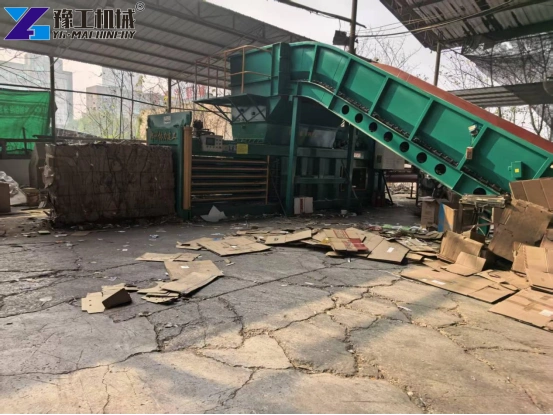
To give your engineering team total clarity, we have broken down the core technical parameters of the three most popular horizontal balers for sale in today’s market:
| Comparison Vector | Clamping-Arm Horizontal Baler | Lifting-Gate Horizontal Baler | Energy-Saving Servo Baler |
| Core Technology Feature | Dual-side clamping mechanical press | Hydraulic vertical lifting discharge gate | Patented composite cylinder + servo drive |
| Rated Ram Thrust Force | 1600 KN to 2500 KN | 1600 KN to 2500 KN | 2000 KN to 3000 KN |
| Cylinder Finish Method | Internal rolled barrel wall finish | Internal rolled barrel wall finish | Composite intensifying internal valving |
| Single Cycle Time | Approx. 50–60 Seconds | Approx. 60–70 Seconds | Approx. 35–45 Seconds (50% faster) |
| Equipment Footprint Analysis | Longer longitudinal line, narrower frame | Minimal transverse footprint, tight spaces | Compact design, low transformer demand |
| Total Operational Energy | Standard draw (Asynchronous setup) | Standard draw (Solid cast baseplate) | Slashed by 40%–50% (Zero idle draw) |
| Best-Fit Waste Streams | Cardboard boxes, corrugated paper, trash | PET bottles, high-elastic plastic film | High-volume solid waste, 24/7 heavy duty |
✍ Selection Tip: If your warehouse workspace is extremely limited, the lifting-gate design is your best bet. Because the door opens upward rather than swinging outward, the transverse equipment footprint analysis is tiny, lowering your site layout restrictions.
Mapping Models to Real Industrial Workflows
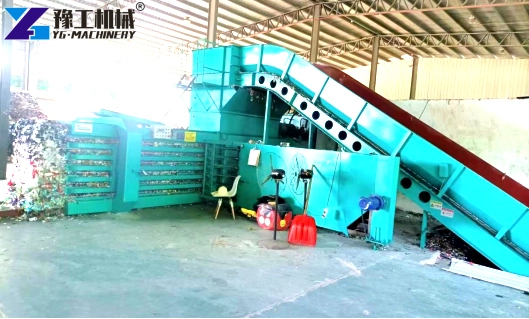
Scenario 1: Standard Cardboard Recycling & Loose Paper Yards
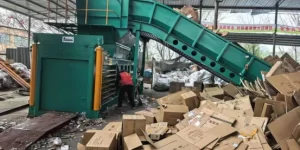
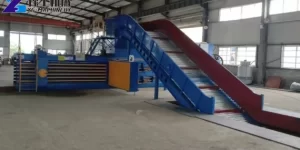
If your facility primarily processes mixed grocery boxes and loose newspapers, a horizontal cardboard baler with a clamping-arm design offers the best value. The modern clamping mechanism generates exceptional lateral friction to optimize baling density. Combined with our automated threading hooks, it supports non-stop production.
Scenario 2: High-Springback PET Bottles & Plastic Film Plants
Never use a standard clamping-arm machine for PET bottles. Plastic has an incredible memory and expands violently when pressure is released. You need a specialized lifting-gate model. This setup accommodates specialized anti-rebound teeth. Its stationary slide is cast as a single solid unit lined with wear-resistant alloy steel plates, eliminating the classic gate-jamming issues common on cheaper welded frames.
Scenario 3: Extreme Electric Rates or Weak Local Power Grids
If your facility is located in a remote area with a weak infrastructure that cannot support a dedicated power transformer, an energy-saving model is a lifesaver. The paired motor power is roughly 50% lower than standard setups, yet its composite intensifying cylinder increases actual ram output thrust by 10% to 20%.
Practical Selection Case: Saving an Australian Buyer from a $30,000 Grid Trap
Last year, a commercial recycler from Australia named Mr. Luke approached me looking for a dependable waste baler machine. He was heavily leaning toward a competitor’s high-power, traditional 250-ton machine. However, he overlooked a critical detail: his yard sat at the end of a rural grid line that could not handle the massive peak amperage spike required to start a standard heavy asynchronous motor. To run it, he would have to pay his local utility provider over $30,000 just to install a dedicated transformer.
After reviewing his power profile, I advised him to bypass traditional configurations and select our YG-200 Energy-Saving Automatic Baler Machine.
Because our smart servo hydraulic system delivers stepless speed adjustments and high tonnage density at lower total power levels, his overall operating costs dropped by 40% to 50%. Luke started production smoothly without making a single modification to his local power grid. The machine runs noticeably quieter, maintains a cool hydraulic oil viscosity level, and saves him thousands in monthly utility surcharges.
✍ Selection Tip: Always track your regional hydraulic oil viscosity requirements. In extreme climates, a servo hydraulic system is far superior because it generates minimal heat, preventing oil breakdown without needing large, power-hungry cooling fans.
24-hour sales hotline: +8613837112713
Frequently Asked Questions on Machinery Selection & Pricing
Wire management depends entirely on mechanical alignment and manufacturing tolerances. Our patented automatic wire-tying mechanism ensures precise needle strokes. As long as you use standard-spec baling wire and clear out tiny paper shreds from the cutter path once a week, you will rarely face unexpected knotting faults or wire breakage.
The secret lies in our internal composite intensifying valving design. This system alters fluid distribution dynamically inside the cylinder. By optimizing the internal piston surface area efficiency, it packs 10% to 20% more crushing force into a compact frame without demanding a larger, power-hungry motor.
Look closely at your shipping logistics. Higher tonnage means tighter bales. If you plan to load finished bales into ocean freight containers for export, we highly recommend choosing a model of 200 tons or more. This ensures your bale weights cross the 1-ton threshold, allowing you to max out container payload weights and save a fortune on maritime freight fees.